
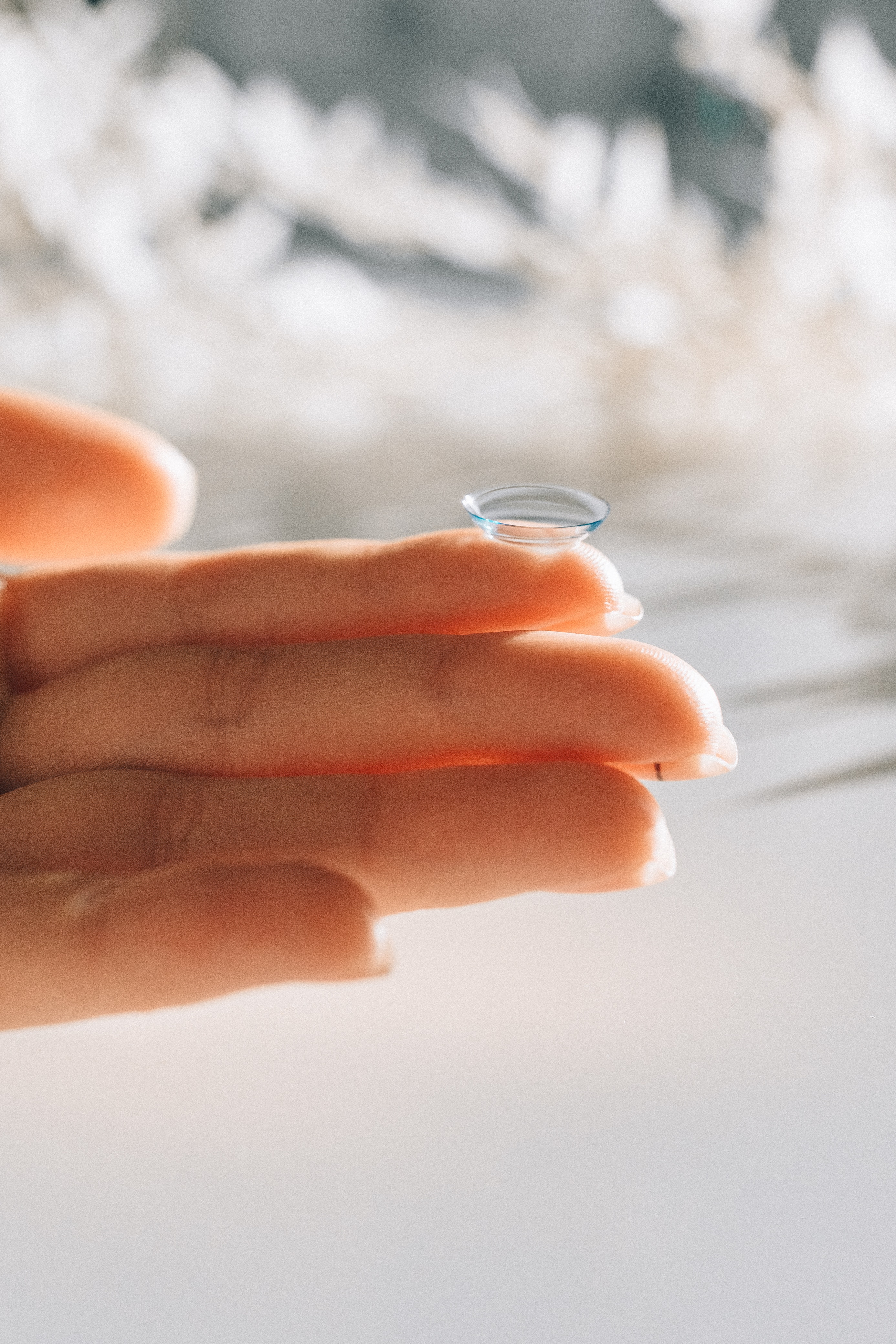
For some people, contact lenses are essential, and for others they are simply preferred. They can be worn daily, or just on the odd occasion. Whatever the reason, if you’d like to try contact lenses, the choice is yours.
What we do…
Contact Lens Assessments
For people who don’t currently wear contact lenses but would like to, we provide an inclusive trial package for £60. This includes the cost of the trial lenses and an initial trial appointment in which the Optician will assess contact lens suitability for your eyes and your lifestyle. We won’t let you take any lenses away until we are comfortable you can put them in and take them out correctly. This may mean we get you in on multiple occasions to continue teaching you, at no extra charge. Finally, the package includes your follow-up appointment after a few weeks, where we check that your eyes are not having any adverse effects from the contact lenses, and the Optician can sign off on a suitable prescription.
Contact Lens Check-Ups
For existing contact lens patients, we provide annual routine check-ups to ensure your eyes and contact lens hygiene are still at a high standard. We will also update your contact lens prescription as and when your needs change, and advise if we feel a different style of contact lens might be more suitable.
We can also manage your supply of contact lenses for your convenience, via a monthly plan or order on demand.
Routine contact lens checks for existing wearers are £40 if buying contact lenses through us. For patients who buy their contact lenses elsewhere, the check is charged at £50.
To see our inclusive monthly plan options, click here.
Types of contact lenses
Single Vision
Single vision contact lenses correct only your distance vision. For someone who only has a distance prescription, these can be worn for all activities, however if you have both a distance and a near prescription, you may need to wear glasses over the top of your contact lenses when doing close work.
Monovision
When you need a prescription for both distance and reading, and you don’t want to have to use glasses on top of your contact lenses, it is possible to use one contact lens of each prescription in each eye. This means you will use one eye for close work and your other eye for looking at anything beyond arm’s length.
Multifocal
Multifocals are also used by people who need differing distance and close work prescriptions. They work using concentric rings of graduating prescriptions, giving you everything you need in each lens, and you look through the part of the lens that gives you the required prescription for the distance at which you are working.
Myopia Management
This type of contact lens is specifically designed to slow or stop myopic progression (or shortsightedness) in children, while also correcting the vision. It does this by defocusing the periphery, which in turn reduces the growth of the back of the eye which causes myopia.
Soft Lenses
These are the most common type of contact lenses which are made from a soft jelly-like material, making these normally the most comfortable type of lens. Depending on the type, soft lenses are replaced either daily, fortnightly, or monthly.
Gas Permeable Lenses
Gas permeable lenses are rigid lenses which don’t contain any water, unlike soft lenses. They are generally less common, as new contact lens wearers find soft lenses more comfortable and easier to get used to.
Toric Lenses
While normal contact lenses do not correct astigmatism, toric lenses do account for the cylindrical value of a prescription. Most lens types (single vision, multifocal, soft, gas permeable, etc) have a toric option for people with astigmatisms higher than 0.75.
DOs and DON’Ts of Reusable Contact Lenses
DO…
DON’T…
- Have regular check-ups as advised by your eye care practitioner
- Always wash and dry your hands prior to handling your lenses
- Always rub, rinse and store your lenses in the recommended solution before and after each use (except single-use lenses, which should be discarded after each wear)
- Always clean the lens case with solution, wipe with a clean tissue then air-dry after each use by placing the case and lids face down on a tissue
- Always apply the same lens first to avoid mixing them up
- Check the lens is not inside out before applying
- Check the lens is not damaged before applying
- Handle carefully to avoid damaging the lens
- Apply your lenses before putting on make-up
- Remove lenses then remove make-up
- Keep your eyes closed when using hairspray or other aerosols
- Replace your lens case at least monthly
- Discard lenses and solutions that are past their expiry date
- Wear only the lenses specifed by your eye care practitioner
- Recycle contact lenses at an approved recycle point where possible
- Stick strictly to the recommended wearing schedule and replacement frequency
- Make sure you have an adequate supply of replacement lenses
- Have an up-to-date pair of spectacles for when you need to remove your lenses
- Use tap water, or any other water, on your lenses or lens case
- Use your lenses for swimming, hot tubs or water sports
- Sleep in your lenses, unless specifically advised to by your eye care practitioner
- Touch the inside of the lens (the side that touches the eye)
- Share contact lenses or wear any lenses not specified by your eye care practitioner
- Wet your lenses with saliva
- Put a lens on the eye if it falls on the floor or other surface, without cleaning and storing again
- Re-use or top up solution – discard and replace with fresh solution each time lenses are stored
- Decant solution into smaller containers
- Wear lenses left in the case for more than seven days without cleaning and storing them in fresh solution
- Wear your lenses when showering
- Switch the solution you use, except on the advice of your eye care practitioner
- Use any eye drops without advice from your eye care practitioner
- Apply a lens if it is dirty, dusty or damaged
- Continue to wear your lenses if your eyes don’t feel good, look good, or see well.
 Cotswold Eye Care Centre Ltd